
Como más de una vez he dicho, me gusta enormemente la cosa naval, pero, desgraciadamente vivo en un país en el que los temas navales son irrelevantes para una gran mayoría de población – algo así como si viviéramos de espaldas a la mar – y, a consecuencia de ello, los medios de comunicación tampoco facilitan información más allá de lo básico, pero, eso sí, ponen gran énfasis en la comidilla relacionada con las personas involucradas en las tragedias marítimas, máxime si aquellas son relevantes; es el caso del velero «Bayesian», de cuyo reciente hundimiento hay hartazgo informativo sobre las personas fallecidas en él, pero, escasea lo relacionado con aspectos técnicos del velero y, mucho de lo publicado, parece opinión de personas que han interpretado mal los pocos buenos planos y las muchas fotografías del barco, algo no censurable cuando no media intención de engañar, o deseo de quedar bien con el manda mal.
Tras condolerme con los familiares de los fallecidos, hoy día 30-8-2024, diez días después del hundimiento del «Bayesian», trataré de explicar determinados aspectos técnicos del barco, no sin antes aclarar que, para ello, he consultado los documentos «bayaesian-formerly-salute_brochure. pdf», «Perini-Navi-SY-56m-C2392-EVOLUTION.pdf», «Página: https://www.sailingscuttlebutt.com/2024/08/27/former-bayesian-captain-offers-insight/ » y ciertas fotografías del barco, todo ello fácilmente localizable en internet.
Como es natural, ambos .pdf son folletos puramente comerciales, de modo que muchos de sus aspectos técnicos no se aprecian en ellos, pero, obviamente, vale más eso que nada. También afirmo que, de todo lo que he oído y leído sobre este barco, es la información facilitada por el ex capitán del barco, Mr. Stephen Edwards – mencionada en la página web anterior – la más fiable.
Con los datos ofrecidos por los .pdf citados, especialmente del primero y algunas fotos del barco, he trazado su plano de formas (imagen 1) que, naturalmente, no será idéntico al del «Bayesian», pero, su aproximación será la suficiente como para poder obtener de él la información que sigue.
As I have said more than once, I am hugely interested in all things naval; unfortunately, however, I live in a country where naval matters are irrelevant to the vast majority of the population – it is as if we were living with our backs to the sea. Consequently, the media provides little information beyond the basics, though they do place great emphasis on gossip surrounding the people involved in maritime tragedies – especially if those individuals are prominent figures. This is the case with the sailing yacht «Bayesian»; while there has been an information overload regarding the victims of its recent sinking, there is a scarcity of details concerning the vessel’s technical aspects. Much of what has been published appears to be the opinion of people who have misinterpreted the few accurate plans and the many photographs of the ship—something not to be criticized, provided there is no intent to deceive or desire to curry favor with those in charge.
After offering my condolences to the families of the deceased, today – August 30, 2024, ten days after the *Bayesian* sank – I will attempt to explain certain technical aspects of the vessel. I should first clarify that I have consulted the documents «bayesian-formerly-salute_brochure.pdf» and «Perini-Navi-SY-56m-C2392-EVOLUTION.pdf,» the webpage https://www.sailingscuttlebutt.com/2024/08/27/former-bayesian-captain-offers-insight/, and various photographs of the ship – all of which are easily found online.
Naturally, both PDF files are purely commercial brochures, meaning many technical details are not evident in them; still, having them is obviously better than having nothing at all. I also maintain that, of everything I have heard and read about this vessel, the information provided by its former captain, Mr. Stephen Edwards – mentioned on the aforementioned webpage – is the most reliable.Using the data from the cited PDFs (especially the first one) and some photographs of the vessel, I have drafted its lines plan (Image 1); while naturally not identical to that of the «Bayesian», it is sufficiently accurate to derive the information that follows.

De todo lo publicado, quizá sean la orza y el mástil del barco sus componentes más sometidos a controversia, la primera a causa de su forma, tamaño, peso y funcionalidad, y el segundo por su altura y peso. La orza es un apéndice del casco prácticamente exclusivo de las embarcaciones propulsadas a vela, y desempeña fundamentalmente dos funciones: oponerse a la escora (inclinación) del barco que el viento provoca al actuar sobre velas, casco, mástil y superestructura, además de impedir, en la medida de lo posible, su desplazamiento transversal a causa del mismo empuje. Así pues, la orza es un elemento fundamental en todo velero, y su dimensionamiento debe adoptarse tras cálculos hechos con datos cuidadosamente elegidos, tales como tamaño del barco, superficie vélica (área de las velas) y máxima velocidad del viento.
El mástil también es un componente típico de cualquier velero que se calcula tomando en consideración su superficie vélica, empuje máximo del viento, tamaño del barco, etc.
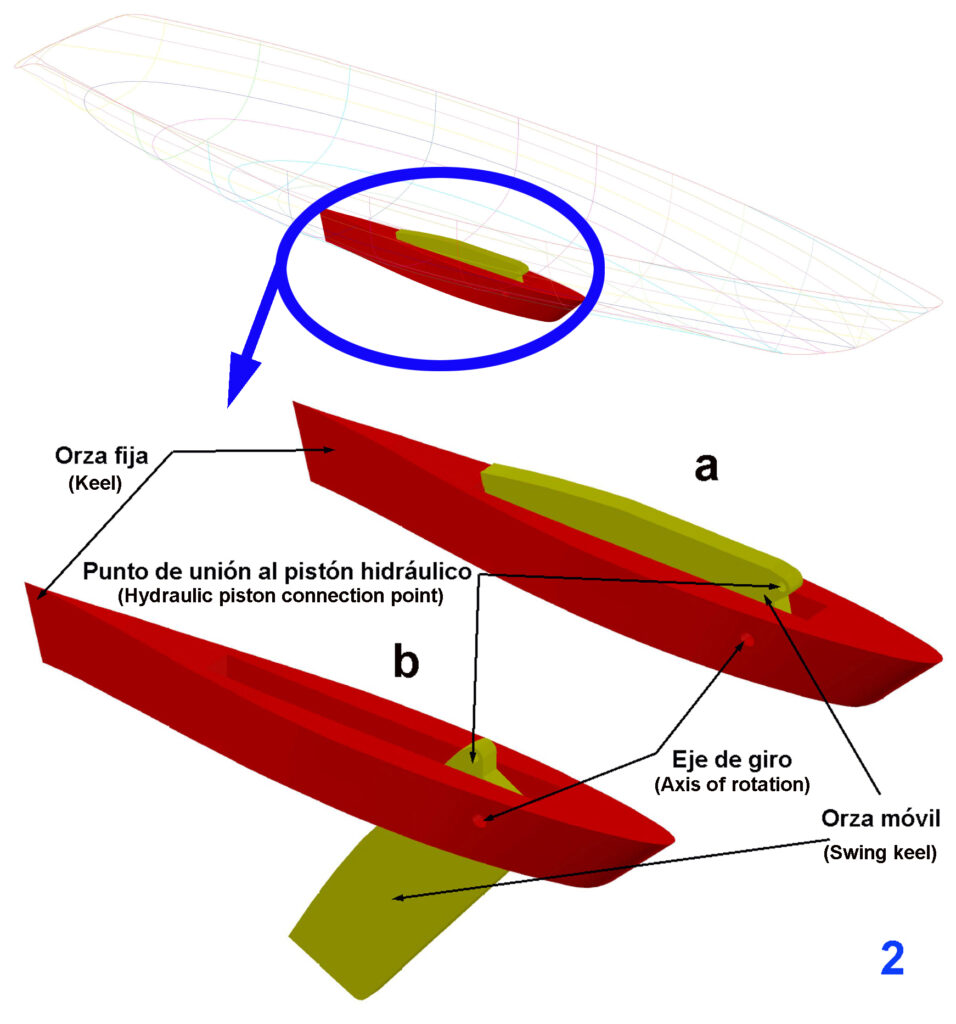
Ahora relataré lo que creo pudiera ser la orza del «Bayesian», para ello, me he basado en los .pdf y página web antes mencionados. Pues bien, en la imagen 1 está señalada la parte exterior de su orza fija: un bloque de acero – supongo que es este el material de la que está hecha, pues no recuerdo haber leído nada sobre este tema – con su sección transversal paralela a la superficie de flotación con forma hidrodinámica (probablemente un perfil NACA), unida al casco del barco (de aluminio), posiblemente con tornillos. Esta orza (la roja de la imagen 2) tiene un hueco central con forma más o menos paralelepipédica en el que se aloja otra (la de color oliva) que mediante un sistema hidráulico puede estar en la posición “a” (subida) o en la posición “b” (bajada), según necesidades de navegación. La orza en posición “b” confiere al barco una estabilidad superior a la de la posición “a”, por eso el ex capitán del barco, Mr. Stephen Edwards, menciona que, con las velas desplegadas, se debe navegar en posición “b”, por ser esta posición la que más contrarresta la tendencia del barco a escorarse (inclinarse) por efecto del viento.
Of all the published information, the boat’s keel and mast are perhaps the most controversial components – the former due to its shape, size, weight, and functionality, and the latter due to its height and weight. The keel is a hull appendage found almost exclusively on sailing vessels; it performs two fundamental functions: resisting the heeling (tilting) caused by the wind acting on the sails, hull, mast, and superstructure, and preventing – as much as posible – lateral drift resulting from that same wind force. Thus, the keel is a crucial element of any sailboat, and its dimensions must be determined through calculations based on carefully selected data, such as the boat’s size, sail area, and maximum wind speed.
The mast is another typical sailboat component; its specifications are calculated by taking into account factors such as sail area, maximum wind thrust, and boat size.
I will now describe what I believe to be the «Bayesian»’s keel, based on the aforementioned PDF documents and website. Image 1 highlights the exterior section of its fixed keel: a steel block – I assume it is steel, as I do not recall reading anything specific about the material – featuring a hydrodynamic cross-section (likely a NACA profile) parallel to the waterline and attached to the (aluminum) hull, possibly with bolts. This keel (the red one in Image 2) contains a central, roughly parallelepiped-shaped cavity housing a second keel (the olive-colored one). A hydraulic system allows this inner keel to move between position «a» (raised) and position «b» (lowered), depending on sailing requirements. The centerboard in position “b” provides the boat with greater stability than in position “a”; for this reason, the former captain, Mr. Stephen Edwards, notes that the boat should be sailed in position “b” when the sails are deployed, as this position best counteracts the boat’s tendency to heel (lean) due to the wind.
Tras los trazados del plano de formas y de las orzas, determiné el peso de estas y la curva de desplazamiento correspondiente a ese plano:
Resultados:
Peso de la orza fija: 195 T
Peso de la orza móvil: 60 T
Peso total de ambas orzas: 255 T
Considerando que las geometrías que he trazado, las decidí con datos deducidos de los documentos ya mencionados y de fotografías tomadas de perspectivas desfavorables del barco, los datos cuadran perfectamente con los facilitados por el ex capitán del barco.
Los informativos han hecho mucho énfasis sobre la gran altura de su mástil, e incluso algunas han apuntado que su posible rotura (todavía no se sabía que el mástil no se había partido) favoreció la escora del «Bayesian», esto es simplemente un error de concepto, pues una rotura de mástil baja el centro de gravedad del barco y además disminuye el empuje del viento sobre él, lo que favorece su estabilidad; distinto es si se rompe con la vela desplegada (el «Bayesian» estaba fondeado y, obviamente, sin velas), pues la acción del agua sobre ellas puede complicar la situación.
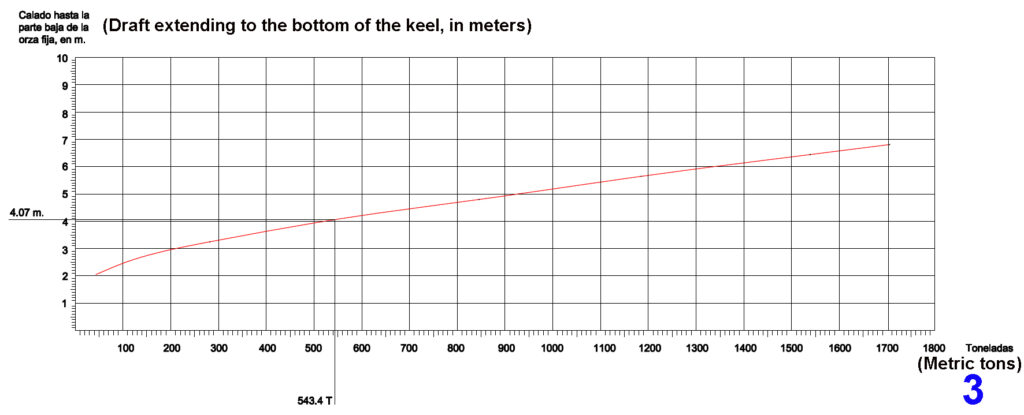
La curva de desplazamiento, de este o de cualquier otro barco, es la que determina su desplazamiento en función del calado; en el caso que nos ocupa es la mostrada en la imagen 3. Así mismo, por el documento «bayaesian-formerly-salute_brochure. pdf» sabemos que el desplazamiento máximo del «Bayesian» es de 543,4 T, dato que llevado la curva de desplazamiento arroja un calado de 4,07 m. Ahora vamos a suponer hundido al barco, lo que supondría que su teórica línea de flotación pasaría por su extremo de proa más alto, de modo que en esa situación el barco tendría su calado máximo, correspondiente a poco más de 1.700 T. El resultado de restar ambos desplazamientos sería el peso necesario para hundir el barco desde su condición de máximo desplazamiento permitido, o sea, unas 1.156 T, o lo que es lo mismo tratándose de agua (para mayor comodidad considero la densidad de 1 T/m³, en vez de 1,04) 1.156 m³.
Based on the lines plan and the keel designs, the weight of the keels and the displacement curve corresponding to that plan were determined:
Results:
Swing keel weight: 60 t
Fixed keel weight: 195 t
Total weight of both keels: 255 t
Considering that the geometries I plotted were based on data derived from the aforementioned documents and photographs taken from unfavorable angles, the figures align perfectly with those provided by the ship’s former captain.
News reports have placed great emphasis on the extreme height of the mast; some even suggested that a potential breakage (it was not yet known that the mast had not snapped) contributed to the «Bayesian»’s listing. This is simply a conceptual error, as a mast breaking actually lowers the ship’s center of gravity and reduces wind load, thereby improving stability. The situation would differ if the mast broke while the sail was deployed – though the «Bayesian» was at anchor and, obviously, had no sails up – since the water’s action on the sails could complicate matters.
The displacement curve for this or any other vessel determines its displacement based on draft; in this specific case, the curve is shown in Image 3. Furthermore, the document «bayesian-formally-salute_brochure.pdf» indicates that the «Bayesian»’s maximum displacement is 543.4 t; applying this figure to the displacement curve yields a draft of 4.07 m. Now, let us assume the ship is submerged to the point where its theoretical waterline passes through its highest point at the bow; in this state, the ship would be at its maximum draft, corresponding to a displacement of just over 1,700 tonnes. The difference between these two displacement values represents the weight required to sink the ship from its maximum permitted displacement condition – that is, approximately 1,156 tonnes, or, in terms of water volume (using a density of 1 tonne/m³ for simplicity, rather than 1.04), 1,156 m³.
De lo dicho se deduce:
- Si el tiempo mínimo que algunos han dado para el hundimiento del barco ha sido de 2 minutos, en el barco entró agua con una cadencia de 9.63 m³/s.
- También se han dado 16 minutos como tiempo máximo del hundimiento, lo que equivale a un caudal de entrada de agua al interior del barco de 1.2 m³/s.
creo que un caudal comprendido entre ambos debió de ser el real.
Llagados aquí surge la pregunta ¿por dónde le entró al barco semejante cantidad de agua? Descartando un sabotaje que podría haberle causado brechas al «Bayesian» en su banda de estribor (no visible para los buzos, por estar apoyado sobre esa banda en el lecho marino), los únicos sitios del «Bayesian» por los que pudo entrar agua son sus varias escotillas de acceso a al interior, tomas y salidas de aire para ventilación y para funcionamiento de los motores, etc., exceptúo los portillos (ventanas) de los camarotes, que, como dijo Mr. Stephen Edwards, están pegadas al casco y no se pueden abrir, bien es cierto que podrían haberse roto por efecto del temporal, en cuyo caso también ellos contribuyeron a la entrada de agua. Además, debe tenerse en cuenta que el barco tiene mamparos (tabiques interiores) estancos dotados con puertas igualmente estancas, con objeto de incomunicar los espacios comprendidos entre ellos, en caso de inundación. En cualquier caso, la documentación que poseo no me permite trazar el plano que señale todas estas aberturas, algo que sería muy ilustrativo. Otra pregunta ¿Cómo entró el agua por ellos si ninguno está por debajo de su línea de flotación? Solo hay una respuesta: según han dicho muchos informadores, bajo los efectos del temporal – o lo que fuera – el barco se escoró (inclinó) hacia el costado de estribor (derecho) hasta el extremo de superar su ángulo de estabilidad nula (ángulo a partir del cual el barco no se adriza por sí mismo. o sea ponerse vertical en su posición normal de flotación), una posición del barco que sitúa bajo el agua a muchas de las aberturas mencionadas, especialmente las de estribor.
Para que el agua entre por las aberturas mencionadas tienen que estar abiertas en el momento en que la tromba de agua, o el meteoro que fuera, sacudió al «Bayesian». También creo que las puertas estancas de los mamparos estaban abiertas en ese momento, de lo contrario es imposible entender tan rápido hundimiento. Sea como fuere, las autoridades italianas decidirán en su momento lo que realmente ocurrió, para lo que les vendría muy bien poner el barco en seco.
Reflexiones:
- Lo diga quien lo diga, ningún barco es insumergible, pues, inexorablemente, todos deben cumplir el principio de Arquímedes, por lo que cuando, por las razones que sean, su peso iguala o supera el máximo volumen de agua que puede desplazar, el barco se hunde.
- Los barcos como el «Bayesian» no se construyen a capricho de sus diseñadores y constructores, pues, entre otros, están sujetos a determinados reglamentos de construcción, ciertas partes del barco se calculan y, además, sus modelos o cualquier otro componente se someten a prueba para conocer su comportamiento real.
- Como cualquiera puede entender, ningún barco se diseña con datos meteorológicos de efectos desconocidos (¿pudo ocurrirle algo así al «Bayesian»?), se diseña sobre datos sobradamente conocidos.
- No entiendo que una tripulación, sea o no la del «Bayesian», no prepare su barco para afrontar una tormenta, como mínimo, cerrando todos los elementos del barco antes mencionados.
- Quienes voluntariamente crean y difunden información falsa, convierten en malvada a una profesión admirable como es la de informar.
From the foregoing, we can deduce the following:
1. If the minimum time cited by some for the ship’s sinking is 2 minutes, water must have entered the vessel at a rate of 9.63 m³/s.
2. A maximum sinking time of 16 minutes has also been cited, which corresponds to an inflow rate of 1.2 m³/s.
I believe the actual rate likely fell somewhere between these two figures.
This raises the question: where did such a massive volume of water enter the ship? Ruling out sabotage – which could have caused breaches in the «Bayesian»’s starboard side (invisible to divers because the vessel is resting on that side on the seabed) – the only possible entry points are the various access hatches leading to the interior, air intakes and exhausts for ventilation and engine operation, and so forth. I exclude the cabin portholes (windows), which, as Mr. Stephen Edwards noted, are bonded to the hull and cannot be opened – though admittedly, they could have shattered due to the storm, in which case they too would have contributed to the water ingress. Furthermore, it must be noted that the ship is equipped with watertight bulkheads (internal partitions) and corresponding watertight doors designed to isolate the spaces between them in the event of flooding. In any case, the documentation I possess does not allow me to draw up a plan marking all these openings – something that would be highly illustrative. Another question arises: how did water enter through these points if none of them are located below the waterline? There is only one answer: according to many reports, under the impact of the storm – or whatever weather event occurred – the vessel listed (tilted) to starboard (the right side) to the point of exceeding its angle of vanishing stability (the angle beyond which the ship will not right itself – that is, return to a vertical, normal floating position). This position submerged many of the aforementioned openings, particularly those on the starboard side.
For water to enter through those openings, they must have been open at the moment the waterspout – or whatever weather phenomenon it was – struck the «Bayesian». I also believe the watertight bulkhead doors were open at the time; otherwise, it is impossible to explain such a rapid sinking. In any case, Italian authorities will eventually determine what actually happened, a process that would be greatly aided by bringing the vessel ashore.
Reflections:
a) No matter who says otherwise, no ship is unsinkable; all vessels must inevitably obey Archimedes’ principle. Consequently, when – for whatever reason – a ship’s weight equals or exceeds the maximum volume of water it can displace, it sinks.
b) Vessels like the «Bayesian» are not built based merely on the whims of their designers and builders; they are subject to specific construction regulations, key components are engineered through calculation, and models – or other parts – undergo testing to determine their actual behavior.
c) As anyone can understand, ships are not designed based on weather data involving unknown effects (could something like that have happened to the «Bayesian»?); rather, they are designed using well-established, known data. d) I cannot fathom a crew – whether or not it is the «Bayesian»’s—failing to prepare their vessel to face a storm by, at the very least, closing all the aforementioned elements of the ship.
e) Those who deliberately create and spread false information turn the admirable profession of something malicious.